



Buyers Have Leverage. Sellers Have a Playbook.

Bob Engel
As a real estate professional with over thirty-five years of national real estate experience, Bob has the strong industry knowledge rarely found in re...
As a real estate professional with over thirty-five years of national real estate experience, Bob has the strong industry knowledge rarely found in re...
Turning Market Corrections Into Opportunity: The Front Range Playbook for Buyers and Sellers
The Colorado Front Range residential real estate market has clearly shifted. For buyers, that shift may feel like long-overdue lemonade. More inventory, longer days on market, reduced showing pressure, builder incentives, price reductions, seller concessions, and rate buy-down opportunities are all giving buyers a level of negotiating leverage they have not enjoyed in years.
But this is not only a buyer story. For sellers, the lemonade is different, but just as important: a forward-looking pricing strategy can help them successfully navigate the correction with confidence, protect their equity, and avoid the larger losses that often occur when sellers cling to outdated peak-market valuations.
In other words, this market is not simply rewarding buyers and punishing sellers. It is rewarding preparation, pricing discipline, and sound execution.
Warren Buffett has long embraced the view that down markets can create as much wealth as up markets, but only for those who act with a disciplined plan. The same principle applies to residential real estate. Rising markets reward speed. Correcting markets reward strategy.
The National Perspective: A Market Cooling Into Discipline
Nationally, housing is not collapsing, but it is becoming more disciplined. Existing-home sales rose just 0.2% month over month in April 2026 to a seasonally adjusted annual rate of 4.02 million, while unsold inventory increased to 1.47 million homes, equal to a 4.4-month supply. The national median existing-home price still rose 0.9% year over year to $417,700, which shows that the national market remains resilient, but no longer overheated.
Realtor.com described April 2026 as a “buyer-friendly spring,” with active listings above one million, national list prices down year over year for the sixth consecutive month, and 16.7% of active listings showing price reductions. That is the national theme: sellers are still transacting, but buyers are becoming more selective and sellers are having to compete again.
Mortgage rates remain the largest affordability obstacle. Freddie Mac’s Primary Mortgage Market Survey showed the average 30-year fixed mortgage rate at 6.51% as of May 21, 2026. Rates above 6% are now the operating baseline, and that has changed buyer behavior. Buyers are not just asking, “What is the price?” They are asking, “What is the payment?”
That payment-sensitive mindset is exactly why seller concessions, closing-cost credits, escrow assistance, and rate buy-downs have become so important.
Characteristics of Today’s Denver and Front Range Market
Today’s Denver and Front Range market is defined by a combination of stability on the surface and pressure underneath.
DMAR reported that April 2026 posted a Denver metro median close price of $605,000, nearly unchanged from April 2025 at $604,000 and April 2024 at $602,000. At the same time, active listings rose to 11,539, up 17.19% from March, giving buyers expanded selection without yet producing a broad pricing breakdown.
That distinction matters. The market has not fallen apart. But leverage has shifted.
The Colorado Association of REALTORS described the seven-county Denver metro market as balanced to slightly buyer-favorable from a negotiation standpoint. In April, homes took an average of 44 days to sell, up from 42 days a year earlier, while the year-to-date average was 58 days. The attached-home segment was even more buyer-favorable, with 5.7 months of supply and 56 days on market.
Showing activity also reflects a more selective buyer pool. ShowingTime reported that February 2026 showing traffic was down 5.2% year over year across the United States. Fewer showings do not mean no buyers. They mean buyers are more cautious, more analytical, and less willing to reward overpriced listings.
Builder competition is adding another source of pressure. NAHB reported that 36% of builders cut prices in April, with an average price reduction of 5%, while 60% used sales incentives. These builder price cuts and incentives are not isolated events; they create direct competitive pressure on resale homes, especially when new construction offers rate incentives, closing-cost assistance, and move-in-ready condition.
Realtor.com’s April 2026 data showed Denver-Aurora-Centennial with 24.3% of active listings carrying price reductions, compared with 16.7% nationally. Denver’s median list price was $587,000, down 2.1% year over year, while the median list price per square foot was down 3.2%.
That is the market reality sellers must face: buyers are still present, but they are no longer chasing. They are comparing, negotiating, waiting, and using competing inventory as leverage.
The Source and Cause of Current Conditions
The roots of this correction go back to the pandemic-era distortion of the housing market.
COVID-19 created a rare and powerful combination: constrained housing supply, emergency monetary policy, fiscal stimulus, historically low mortgage rates, remote-work relocation, and an explosion of buyer demand. Many sellers withdrew or delayed listings during the pandemic, while buyers competed for limited inventory with exceptionally cheap financing.
Between February 2020 and February 2022, the U.S. M2 money supply increased from $15.493 trillion to $21.725 trillion, a gain of approximately 40.2%. M2 includes cash, checking deposits, savings deposits, and other liquid money-like assets. The Federal Reserve also used quantitative easing, which the Congressional Budget Office describes as the Fed’s purchase of large quantities of Treasury securities and mortgage-backed securities to reduce long-term interest rates and increase liquidity.
The result was too much low-cost money chasing too few homes.
That imbalance helped drive prices to unsustainable affordability levels. Then inflation forced the next shock. By June 2022, the Consumer Price Index had risen 9.1% year over year, the largest 12-month increase since November 1981. The Federal Reserve responded with aggressive rate increases, and the housing market was left with the worst affordability combination: elevated prices and elevated borrowing costs.
That is the correction now working through the Front Range market.
It is not simply a real estate problem. It is the free market digesting the aftereffects of a once-in-a-generation economic event.
The Eye-Opening Forward-Looking Signal: Front Range Valuation Forecasts
Current closed-sale data can make sellers feel as though values are holding steady. But closed sales are backward-looking. A successful listing strategy in a correcting market must be forward-looking.
Unless a property is an exceptionally desirable trophy home that can command an above-market sale price, the following Front Range valuation trends should be a core part of the listing-price strategy.
Front Range Residential Valuation
Reventure 12-Month Forecast:
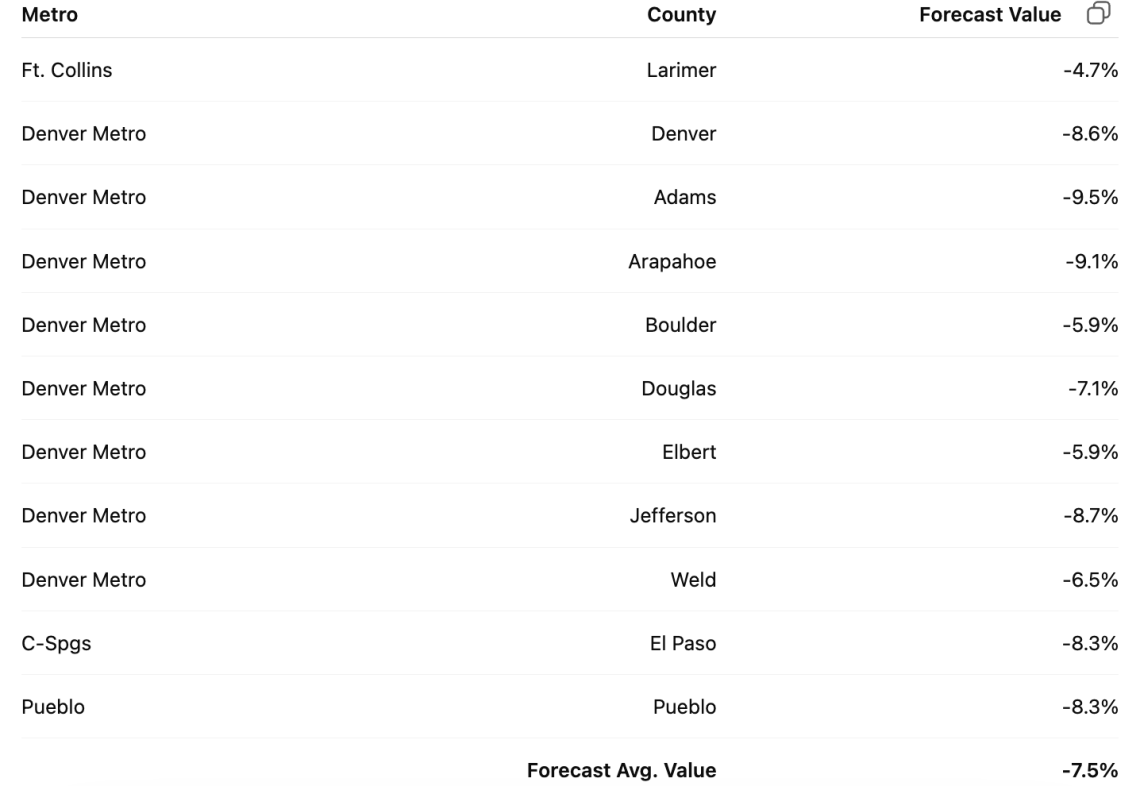
Source: Reventure 12-month forecast values provided for this PTI story draft. Reventure describes its forecast methodology as incorporating supply-and-demand fundamentals, including inventory, price cuts, days on market, mortgage rates, and recent home-value trends.
This chart is the pivot point of the story. For buyers, these forecasted declines create opportunity. They support stronger negotiation, more disciplined offers, and the ability to use price reductions, concessions, and rate buy-downs to improve affordability.
For sellers, these same forecasted declines create urgency. Not panic — urgency. The seller’s opportunity is to price ahead of the correction rather than chase it from behind. That is the seller’s lemonade.
Buyer Opportunities: Turning Market Pressure Into Purchasing Power
For buyers, the current correction may offer one of the best opportunity windows the Front Range has seen in years. The opportunity is not that every home is suddenly cheap. The opportunity is that leverage has returned.
High inventory gives buyers choice. Longer days on market gives buyers time. Price reductions reveal seller motivation. Builder incentives create competitive pressure. Higher rates reduce buyer competition. Sellers with strong equity, especially those who purchased before 2020, often have room to negotiate.
A skilled buyer’s agent can now identify opportunity by looking for listings with multiple signs of seller fatigue: high days on market, prior price reductions, vacant homes, weak showing activity, estate or relocation pressure, builder competition nearby, poor presentation, or attached-home inventory with rising supply.
These are not necessarily distressed homes. They are negotiation-rich homes.
The best buyer opportunities will also be neighborhood-specific. The correction will not affect every Front Range neighborhood equally. Strong neighborhoods with safety, convenience, schools, amenities, commute access, walkability, aesthetics, and a clear sense of community will hold value better than weaker or less convenient areas. The greater pressure will likely appear where affordability is strained, inventory is high, condition is average, and sellers remain anchored to peak-era expectations.
For buyers, the playbook is clear: use data, not fear. A price correction can become a lower purchase price. A motivated seller can become closing-cost assistance. A stale listing can become inspection leverage. Builder price cuts can become resale negotiating power. A high-rate environment can become a seller-funded rate buy-down.
That is how buyers turn lemons into lemonade.
Seller Opportunities: Protecting Equity Through Forward-Looking Pricing
For sellers, the strategy is different. The opportunity is not to wait and hope the market returns to 2021 or 2022. The opportunity is to recognize the correction early and price with enough discipline to win before the market forces deeper cuts.
Today’s volatile market does not require a listing agent to simply provide a marketing plan. It requires a listing strategy. A marketing plan says: “Here is how we will promote the home.”A listing strategy says: “Here is how we will price, position, prepare, negotiate, and protect the seller’s equity in a correcting market.” That distinction is critical.
In a rising market, marketing can sometimes overcome pricing mistakes because appreciation bails out the seller. In a correcting market, overpricing is punished. The first two to three weeks matter more than ever. If a property launches too high, it risks missing the most active buyer pool, accumulating days on market, triggering price reductions, and eventually selling for less than it might have achieved with a stronger initial strategy.
The three most important listing variables are:
Listing Strategy Factor | Strategic Weight
| Neighborhood desirability | 20% |
| Property condition | 30% |
| Current market value | 50% |
The most important phrase is current market value.
Not historical value.
Not emotional value.
Not the neighbor’s peak-era sale.
Not what the seller wants to net.
Current market value.
That is where many sellers will either protect equity or lose it.
The Cost of Chasing the Market Down
When sellers price based on historical sold data in a declining market, they are effectively looking in the rearview mirror. By the time the listing fails to generate offers, the market may have already moved lower.
The cost of that delay can be significant.
Current Price Decrease Averages vs. Days on Market
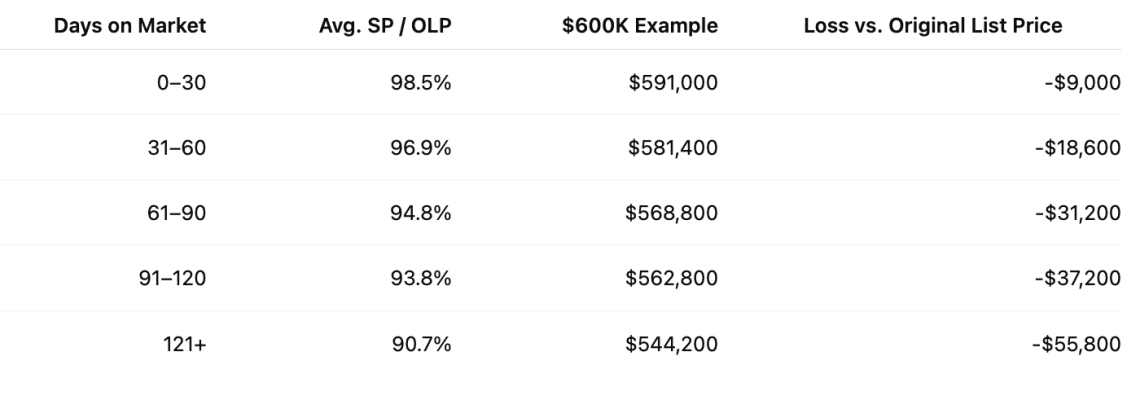
This is the seller’s warning and opportunity at the same time.
A forward-looking price adjustment made at the beginning of the listing is not the same as a forced price reduction after the market has rejected the property. One is strategy. The other is damage control.
A seller who prices correctly on day one may feel like they are giving something up. But in a correcting market, they may actually be protecting themselves from a much larger loss later.
That is the seller’s lemonade: confidence, control, and a disciplined plan that avoids the trap of chasing the market downward.
The Front Range Takeaway
The Colorado Front Range has entered a new market cycle. We are no longer in the pandemic-era environment of mass inbound migration, historically low mortgage rates, limited inventory, bidding wars, and sellers dictating every term. Today’s market is more selective, more payment-sensitive, more negotiation-driven, and more dependent on execution.
That is good news for prepared buyers. It may be one of the best opportunities in years to purchase with choice, leverage, concessions, and strategy. It can also be good news for prepared sellers. The seller who understands the correction, prices forward, prepares the property properly, and negotiates from reality can still sell successfully and protect equity.
The danger is not the market correction itself.The danger is pretending it is not happening.
For buyers, the correction creates purchasing power.
For sellers, the correction creates the need for pricing discipline.
For agents, the correction creates a clear separation between marketing activity and true strategic advice.
The market has changed. The opportunity has not disappeared. It has simply moved to those who recognize the change first and execute with discipline.
That is how both buyers and sellers turn market lemons into lemonade.