



Why Are Colorado Condo Prices Falling? The HOA Crisis Is Worse Than the Headlines Suggest

Bob Engel
As a real estate professional with over thirty-five years of national real estate experience, Bob has the strong industry knowledge rarely found in re...
As a real estate professional with over thirty-five years of national real estate experience, Bob has the strong industry knowledge rarely found in re...
Why Are Colorado Condo Prices Falling? The HOA Crisis Is Worse Than the Headlines Suggest
For years, condominiums and townhomes provided one of the most accessible paths into homeownership—particularly for first-time buyers, retirees, and households unable to afford a detached single-family home.
But across Denver and other Colorado communities, that affordability advantage is beginning to unravel.
Condo prices are falling, monthly HOA dues are climbing, special assessments are becoming more common, and some communities are discovering that their buildings require millions of dollars in repairs they never adequately prepared to fund.
At the same time, stricter condominium lending standards are making it more difficult to finance units in financially or physically troubled developments.
The result is a dangerous feedback loop:
Higher expenses lead to higher HOA dues. Higher dues weaken affordability. Weaker affordability reduces buyer demand. Reduced demand lowers property values—and falling values make it even harder for owners and associations to absorb the next increase.
That cycle—not one isolated problem—is the root cause of Colorado’s developing condo crisis.
THE PRICE DECLINE IS ALREADY VISIBLE
The following Colorado Association of REALTORS® chart tracks the rolling 12-month median sales price for townhomes and condominiums.
Denver County’s rolling median peaked at approximately $450,000 in 2022–2023 and has since fallen to approximately $400,000—a decline of roughly 11% from the peak.
Statewide townhome and condo prices have also retreated, although less severely, from approximately $425,000 at their high point to just over $400,000.
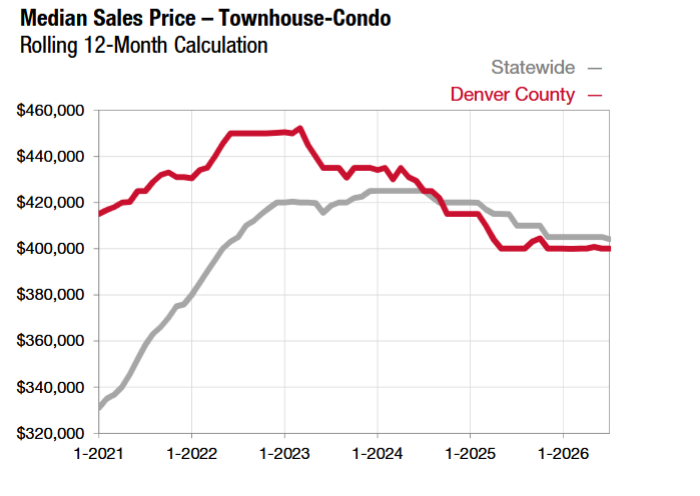
urce: Colorado Association of REALTORS®. Rolling 12-month median sales price through April 2026. The statewide and Denver County figures combine townhomes and condominiums.
The rolling calculation smooths monthly volatility. In other words, the decline is not simply the result of one unusually weak sales month—it represents a sustained market shift.
HOW DID SO MANY ASSOCIATIONS BECOME UNDERFUNDED?
A large portion of Colorado’s older condominium inventory was built—or converted from apartments—during the 1970s, 1980s, and early 1990s.
Many of these developments were intentionally positioned as affordable alternatives to detached homes. Keeping monthly HOA dues low made the units easier to sell, but it also created a long-term temptation: fund today’s operating expenses while postponing adequate contributions for tomorrow’s major repairs.
Owners rarely want their monthly dues increased to replace a roof, elevator, boiler, parking structure, or exterior façade that may continue functioning for another 10 or 15 years.
Unfortunately, those components do not last forever.
Some associations spent decades collecting far less than the amount required to replace their major common elements. Others relied on outdated reserve studies, underestimated construction inflation, or postponed maintenance to avoid unpopular dues increases.
The bills that were deferred are now arriving simultaneously.
THE MATH HAS STOPPED WORKING
Consider an older condominium development where the units are worth approximately $200,000, but the association determines that each owner’s share of roof, exterior, mechanical, or structural repairs is $50,000.
That assessment equals 25% of the unit’s market value.
An owner may not have $50,000 available, and financing the assessment may be difficult or expensive. If multiple owners cannot pay, the association still has to complete the work—meaning the remaining owners may be asked to contribute even more.
This creates the first stage of the downward spiral:
- The association discovers significant deferred maintenance.
- HOA dues increase or a special assessment is imposed.
- Some owners cannot pay.
- The association’s expected revenue falls short.
- Remaining owners must cover a larger share.
- Units become more expensive to own and harder to sell.
- Property values decline.
Lower unit values do not reduce the cost of replacing a roof, elevator, boiler, or structural system. In fact, construction and labor costs may continue rising even while the underlying units lose value.
INSURANCE IS ADDING ANOTHER LAYER OF PRESSURE
Colorado condominium communities are being hit especially hard by insurance costs.
Hail, wildfire exposure, severe weather, rising construction costs, and carriers’ changing risk models have caused premiums and deductibles to increase substantially for many associations. Some communities have also encountered nonrenewals or difficulty obtaining coverage that satisfies mortgage-lending requirements.
A master insurance policy that once fit comfortably within an association’s budget may now require:
- A substantially higher annual premium
- A much larger wind or hail deductible
- Reduced coverage
- Additional owner-carried insurance
- A special assessment to pay the association’s deductible following a loss
An HOA cannot simply eliminate insurance to keep dues affordable. Without acceptable master coverage, owners may be unable to obtain conventional mortgages—and existing owners may have difficulty refinancing.
FANNIE MAE AND FREDDIE MAC ARE FORCING THE ISSUE INTO THE OPEN
Following the 2021 collapse of Champlain Towers South in Surfside, Florida, lenders and federal mortgage agencies increased their scrutiny of condominium safety, deferred maintenance, reserve funding, and insurance.
Fannie Mae’s 2026 condominium changes are especially important. Among other requirements, Fannie Mae:
- Retired its more streamlined Limited Review process for applicable loan applications beginning August 3, 2026
- Strengthened the standards governing reserve studies
- No longer permits a reserve-study funding method that allows reserves to approach zero
- Will increase the standard replacement-reserve allocation used in a Full Review from 10% to 15% of annual budgeted assessment income for applicable applications beginning January 4, 2027
- Requires master-policy coverage generally equal to at least 100% of the estimated replacement cost of project improvements, subject to its detailed insurance rules
These changes are intended to reduce risk and encourage responsible funding. They do not, by themselves, create the underlying financial weakness.
Instead, they expose financial problems that may have been building for years.
A community with inadequate insurance, serious deferred maintenance, excessive owner delinquencies, or an insufficient reserve budget may become ineligible for conventional financing. When that happens, its buyer pool can shrink dramatically.
Cash buyers and specialized lenders may remain available, but they generally expect compensation for the additional risk—and that compensation frequently appears as a lower purchase price.
THE COLORADO COLLECTION PROBLEM
Colorado law gives homeowners meaningful protections before an HOA can take aggressive collection or foreclosure action.
Among other procedural requirements, an association generally must provide detailed notices and offer an eligible delinquent owner an 18-month payment plan before proceeding with foreclosure. More recent legislation requires strict compliance with applicable collection and lien-foreclosure procedures and provides additional notice, mediation, counseling, and sale protections.
These safeguards are understandable because an HOA foreclosure can put an owner’s home and equity at risk.
However, there is another side to the equation: an association depends on assessments from its owners to pay insurance, utilities, maintenance, management, repairs, and reserve contributions.
If owners do not pay, the association cannot stop operating while it waits for the collection process to run its course.
Colorado lien priority also requires careful explanation. A first mortgage is generally senior to most of an association’s assessment lien, although Colorado law gives a limited portion of qualifying HOA assessments priority over a first mortgage. Therefore, saying that every lender foreclosure automatically “wipes out” everything owed to an HOA would be too broad.
Nevertheless, when a mortgage lender forecloses, an association can still lose a significant portion of the delinquent balance that remains junior to the mortgage and is not recovered from the sale proceeds.
That lost revenue is ultimately absorbed by the association—and therefore by its paying owners.
THE NEGATIVE FEEDBACK LOOP
Imagine a 100-unit community where 10 owners fall behind on their assessments.
The roof still has to be repaired. The elevators must still operate. Snow removal, insurance, water, management, and common-area maintenance still have to be paid.
The association has only a few choices:
- Delay maintenance
- Spend reserves intended for future projects
- Increase regular dues
- Levy another special assessment
- Borrow money
- Aggressively pursue collection from delinquent owners
Each choice creates another potential problem.
Deferred maintenance can make the development less attractive and potentially ineligible for conventional financing. Borrowing creates a new monthly expense. Higher dues and assessments can cause additional owners to become delinquent.
The association then has to raise dues again to make up for the new shortfall.
That is the negative feedback cycle threatening some of Colorado’s older, lower-priced condominium communities.
WHY AFFORDABLE CONDOS FACE THE GREATEST RISK
A well-funded luxury building may impose a substantial assessment and still collect it because its owners have greater financial resources.
An older entry-level development faces a much harder reality.
The people who purchased there often did so precisely because they could not afford a more expensive home. A sudden $20,000, $30,000, or $50,000 assessment can exceed their savings and borrowing capacity.
Unfortunately, the roof costs the same amount to replace regardless of whether the individual units are worth $200,000 or $1 million.
That is why the communities intended to provide affordable homeownership may face the greatest risk of financial distress.
THE “SOLUTION” CAN ALSO ELIMINATE AFFORDABILITY
A distressed condo development may eventually attract a well-capitalized investor willing to purchase multiple units, fund renovations, or recapitalize the property.
That may repair the buildings—but it does not necessarily preserve affordable housing.
An investor committing substantial money to roofs, elevators, mechanical systems, insurance, and interior renovations will expect a return. Units that were once relatively inexpensive may be repositioned, rented at higher rates, or resold at prices needed to recover the new investment.
Colorado can therefore lose affordable housing in two different ways:
- The community deteriorates because it cannot fund necessary repairs.
- The community is rescued with private capital but is no longer affordable to its former population.
WHAT CONDO BUYERS SHOULD INVESTIGATE BEFORE MAKING AN OFFER
Buying a condominium can still be an excellent decision, but reviewing the unit itself is no longer enough. Buyers should investigate the financial and physical condition of the entire association.
Important documents and questions include:
- The current operating budget
- The most recent reserve study
- Current reserve balances
- Whether reserve recommendations are actually being funded
- HOA meeting minutes
- Pending or recently completed special assessments
- History of dues increases
- Owner-delinquency levels
- Pending litigation
- Master insurance coverage and deductibles
- Roof, elevator, boiler, plumbing, façade, parking-structure, and mechanical-system condition
- Known structural or safety issues
- Whether the project currently qualifies for conventional financing
- Any lender questionnaire or project-review concerns
- The number of investor-owned or rented units
A low purchase price is not necessarily a bargain if it comes with an underfunded association and a major assessment waiting just beyond closing.
WHAT CURRENT CONDO OWNERS AND SELLERS SHOULD DO
Owners should obtain and read their association’s financial statements, reserve study, budget, insurance summary, and recent meeting minutes—even if they are not currently planning to sell.
If a community has a funding problem, addressing it early may be painful, but waiting usually makes the eventual solution more expensive.
Sellers should also recognize that buyers and lenders are paying much closer attention to association health. Missing records, unresolved insurance questions, pending assessments, or inadequate reserves can disrupt a transaction after the property is already under contract.
Providing complete HOA documentation early—and pricing the property to reflect both the unit and the association’s condition—can prevent lost time and failed contracts.
THE BOTTOM LINE
Colorado condo prices are not falling for just one reason.
Higher mortgage rates and increased inventory have weakened demand across the broader housing market. But condos face an additional collection of pressures: aging buildings, years of inadequate reserve funding, rising insurance costs, expensive deferred maintenance, owner delinquencies, special assessments, and stricter mortgage-project reviews.
The ultimate problem is a breakdown in affordability.
When the combined cost of the mortgage, HOA dues, insurance, assessments, taxes, and future repairs becomes too high, buyers either offer less or walk away. If the project cannot qualify for mainstream financing, the buyer pool becomes smaller still.
Colorado’s condo market is therefore separating into two categories:
Well-maintained, well-insured, adequately funded communities should remain financeable and marketable.
Underfunded communities with deferred maintenance and insurance problems may experience falling values, larger assessments, fewer qualified buyers, and increasingly difficult sales.
The difference between those two outcomes may be buried in hundreds of pages of HOA documents.
Before buying or selling a Colorado condo, understanding the association can now be just as important as understanding the property itself.