



Colorado’s Housing Market Reset: Why Prices Are Softening—and Where the Smart Money Is Moving

Bob Engel
As a real estate professional with over thirty-five years of national real estate experience, Bob has the strong industry knowledge rarely found in re...
As a real estate professional with over thirty-five years of national real estate experience, Bob has the strong industry knowledge rarely found in re...
Colorado’s Market Reset: Why Prices Are Softening—And Where the Smart Money Is Moving
After months of hesitation, the housing market is beginning to stir again—but not in the way most people expect. National headlines are cautiously optimistic. Redfin’s latest data shows pending home sales ticking up 2.7% year-over-year, while mortgage applications have climbed to a three-month high. On the surface, that suggests momentum is returning.
But beneath that surface, something more nuanced is unfolding. This isn’t the return of a housing boom. It’s the emergence of a more calculated, disciplined market—one where timing, pricing, and strategy matter far more than speed. And nowhere is that shift more visible than here in Colorado.
A National Rebound—With Restraint
Across the country, buyers are stepping back into the market—but they’re doing so carefully. They’re watching interest rates.
They’re comparing options. And most importantly, they’re no longer willing to chase homes at any price.
At the same time, sellers are returning as well. Inventory is rising, giving buyers something they haven’t had in years: choice. This combination—moderate demand paired with increasing supply—is quietly reshaping the market dynamic. Homes are still selling, but not instantly. Prices are still holding, but not accelerating.
In short, the national housing market has shifted from a sprint to something closer to a negotiation.
Colorado’s Signal: A Correction, Not a Collapse
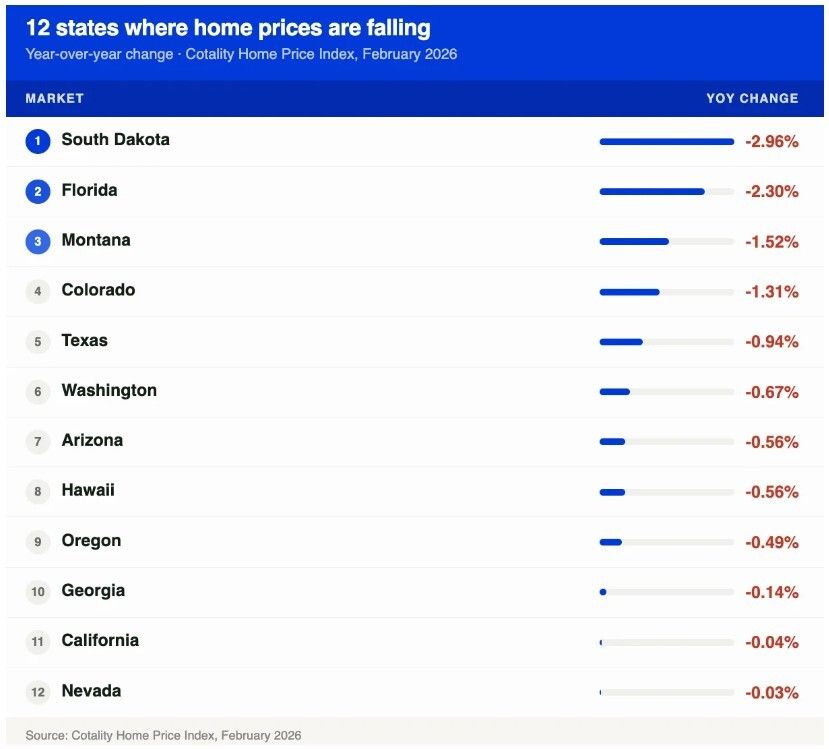
Now layer in the Colorado data—and the story sharpens. According to the Cotality Home Price Index, Colorado ranks as the #4 state in the country for home price declines, with values down 1.31% year-over-year as of February 2026. BiggerPockets highlighted this as one of the most notable shifts in the national landscape.
At first glance, that sounds like a warning sign. In reality, it’s a recalibration.
Colorado experienced some of the most aggressive price growth during the pandemic years. As interest rates climbed and affordability tightened, that rapid appreciation simply became unsustainable. What we’re seeing now is the market doing what it eventually had to do—adjust.
This isn’t distressed selling. It’s not a flood of foreclosures. And it’s not a collapse in demand. It’s pricing realigning with economic reality.
Denver: Where the Shift Is Most Visible
If Colorado is correcting, Denver is where that correction is easiest to see. Inventory has increased noticeably compared to last year, giving buyers more options and more leverage. Homes are spending slightly longer on the market, and price reductions—while not dramatic—are becoming more common.
But here’s the nuance that gets lost in the headlines: Homes aren’t failing to sell. They’re being judged more critically. Well-positioned properties—those priced correctly and presented well—are still moving. The difference is that buyers now have the confidence to walk away from anything that feels overpriced or underwhelming.
This has created a split market:
- Homes aligned with current market expectations are selling efficiently
- Homes anchored to outdated pricing are sitting, adjusting, and negotiating
That distinction is defining outcomes across the Denver metro right now.
Colorado Springs: Stability in a Shifting Market
About an hour south, Colorado Springs is telling a slightly different story. While not immune to broader trends, the Springs market has remained more stable overall. Demand continues to be supported by military presence, relocation activity, and relative affordability compared to Denver.
Prices have softened in some segments, and homes are taking longer to sell than during peak years, but the volatility is far less pronounced. This is not a market swinging sharply in either direction. It’s one that is gradually adjusting—and holding its footing while doing so. For many buyers and investors, that kind of stability is exactly the point.
What This Means—And Why It Matters
When you step back and look at the full picture, the takeaway becomes clear:This is not a market defined by urgency. It’s a market defined by positioning.
Buyers are no longer competing blindly—they’re negotiating. Sellers are no longer setting the pace—they’re adapting to it. Investors are no longer chasing appreciation—they’re underwriting more carefully.
That shift changes how decisions should be made.
For Buyers: Opportunity Has Returned—But It Requires Discipline
For the first time in years, buyers have meaningful leverage. There are more homes to choose from. There’s less pressure to waive protections. And there’s real room to negotiate on price, terms, and concessions. But that doesn’t mean every deal is a good one.
The advantage now lies in being selective—identifying properties where pricing, condition, and seller motivation align. The goal isn’t just to buy a home. It’s to secure one on terms that make long-term sense.
For Sellers: Precision Has Replaced Optimism
Sellers can still succeed in this market—but only with the right approach. The era of “testing the market” with an aspirational price is over. Today’s buyers are too informed, and too patient, for that strategy to work. Instead, success depends on:
- Pricing accurately from the start
- Understanding current competition—not past sales
- Creating strong early momentum within the first two weeks
In this environment, overpricing doesn’t just delay a sale—it weakens your negotiating position.
For Investors: The Market Is Filtering for Discipline
For investors, Colorado’s price softness is not a red flag—it’s a filter. Markets that correct force better decisions. They eliminate speculation and reward fundamentals. That means focusing on:
- Realistic rent assumptions
- True operating costs
- Long-term hold viability
In both Denver and Colorado Springs, opportunities are emerging—but only for those willing to underwrite deals carefully and avoid relying on appreciation alone.
The PrimeTime Takeaway
Colorado’s ranking among the top states for price declines may grab attention—but it doesn’t tell the full story. What’s actually happening is more important:
The market is transitioning from an emotional, momentum-driven cycle to a rational, strategy-driven one. And in markets like this, success doesn’t go to the fastest buyer, the most aggressive seller, or the loudest investor. It goes to the most informed.
If you want to understand how this shift impacts your specific situation—whether you’re buying, selling, or investing in Denver or Colorado Springs—let’s map it out together. Because in a market like this, clarity isn’t just helpful. It’s an advantage.