



More Colorado Homeowners Are Slipping Underwater — Should We Be Worried?

Bob Engel
As a real estate professional with over thirty-five years of national real estate experience, Bob has the strong industry knowledge rarely found in re...
As a real estate professional with over thirty-five years of national real estate experience, Bob has the strong industry knowledge rarely found in re...
Denver isn't facing another 2008. But for some recent buyers, Colorado's housing-market reset is becoming very real.
For most Colorado homeowners, the enormous appreciation of the past decade created something extremely valuable: Equity. But there's another—and growing—group of homeowners experiencing something very different.
They bought near the top of the market. They made relatively small down payments. Mortgage rates subsequently climbed.
And now home values in portions of Colorado have retreated from their pandemic-era highs. The result? Some homeowners are discovering that their home may now be worth less than—or uncomfortably close to—the amount they still owe on their mortgage.
That's called negative equity, or being "underwater." And while Colorado is nowhere close to experiencing another 2008-style foreclosure crisis, negative equity is an important market indicator worth watching—particularly here along the Front Range.
First, What Does "Underwater" Actually Mean?
The concept is surprisingly simple. Suppose someone purchased a home for $600,000 using 5% down. Their starting mortgage would be approximately: $570,000
Now suppose the home's market value subsequently declines 8%. That $600,000 property is now worth approximately: $552,000
The homeowner hasn't necessarily missed a payment. They aren't necessarily in financial trouble. But on paper, they may owe more than the property could sell for after accounting for the mortgage and normal selling expenses.
That's negative equity. And there's an important distinction: Being underwater doesn't cause foreclosure. A homeowner who has stable income and can comfortably make the mortgage payment can simply continue living in the property.
The real problem emerges when negative equity collides with a reason the homeowner needs to sell. Job loss. Divorce. Relocation. Death. Medical expenses. A growing family. Or another financial hardship. That's when an equity problem can become a housing problem.
Negative Equity Is Growing — But Keep the Numbers in Perspective
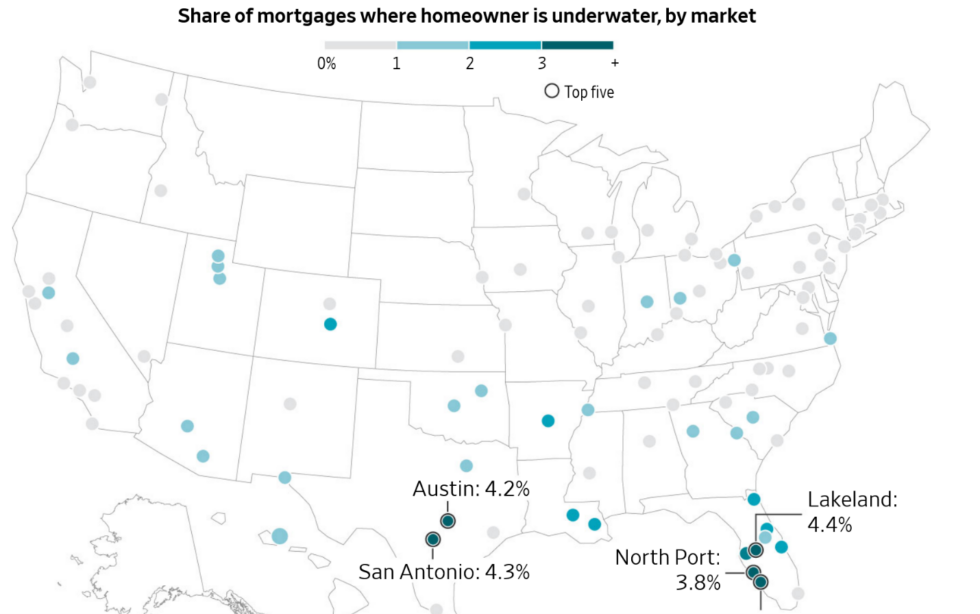
Share of mortgages where the homeowner is underwater, by market. Negative equity is increasing in several pandemic-era boom markets, but even among some of the nation's most affected housing markets, underwater mortgages remain a relatively small percentage of total mortgages.
Source: Original reporting/data graphic reproduced from Fairview Lending, “More Homeowners Now Underwater: What Markets Are Most at Risk?”, August 24, 2026. Confirm publication/reuse permission before reproducing.
The map above provides some important perspective. Even in several of the markets showing the greatest negative-equity exposure, we're talking about roughly 4% of mortgages—not 40%. That's a critical distinction. The concern isn't that most American homeowners are suddenly underwater. They aren't.
Instead, vulnerability is becoming increasingly concentrated among certain homeowners and certain markets—particularly people who purchased near pandemic-era peak prices with relatively small down payments. That distinction is especially important when looking at Colorado.
Why Denver Is More Vulnerable Than Some Markets
Colorado experienced extraordinary home-price appreciation during the pandemic. Record-low mortgage rates, limited inventory, remote work and migration into desirable Western markets created bidding wars and rapidly rising prices.
Then the equation changed. Mortgage rates rose dramatically beginning in 2022. Affordability deteriorated. Buyer demand softened. Inventory increased. And the extraordinary leverage sellers enjoyed during the pandemic disappeared.
The market didn't collapse. It reset. And Denver's longer-term home-value history makes that transition particularly easy to see.
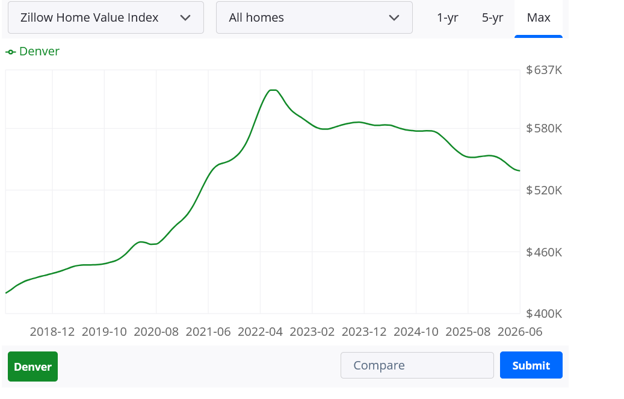
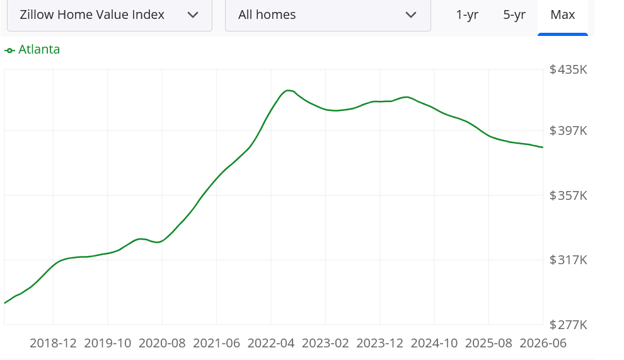
Denver's housing market experienced extraordinary appreciation during the pandemic before reaching its high point around 2022. Values have subsequently moved lower—but remain substantially above pre-pandemic levels. That's why the homeowner's purchase date matters enormously when discussing negative equity.
Source: Zillow Home Value Index. Graphic supplied from source material; verify Zillow attribution/reproduction requirements before publication.
This graph may actually be the most important illustration in this week's story. Look at what happened before the decline. Denver experienced an extraordinary surge in home values between approximately 2020 and 2022. That appreciation created enormous equity for people who already owned homes.
Consequently, someone who purchased a Denver-area property in 2015, 2017 or even 2019 could still be sitting on substantial equity despite today's market correction. Someone who purchased near the 2022 peak with 3.5% down occupies an entirely different financial position.
Same market. Completely different equity story.
KEEP THIS IN PERSPECTIVE
Denver home values retreating from their pandemic-era peak does NOT mean the typical Denver homeowner is underwater. Many long-term Colorado homeowners accumulated enormous equity during the preceding appreciation cycle.
The greatest vulnerability is concentrated among people who: Bought recently + purchased near peak pricing + used a small down payment + haven't owned long enough to build meaningful equity.
That's the homeowner we should be watching.
Two Homeowners. Same House. Completely Different Risk.
Here's where housing-market averages can become misleading. Imagine two homeowners who own essentially identical properties currently worth $600,000.
Homeowner A — The Long-Term Owner
- Purchased years ago for: $350,000
- Current mortgage balance: $250,000
- Current property value: $600,000
- Approximate equity: $350,000
A market decline is unpleasant—but hardly catastrophic. Now consider another homeowner.
Homeowner B — The Recent Buyer
- Purchased near the market peak for: $625,000
- Used a low down payment.
- Current mortgage balance: approximately $590,000
- Current property value: $600,000
After normal selling expenses, Homeowner B could effectively have little or no usable equity. Same neighborhood. Same current home value. Completely different financial circumstances.
That's why simply asking whether "Denver prices are falling" misses the more important question: Who bought, when did they buy, and how much equity do they actually have?
FHA and VA Buyers Deserve Special Attention
Low-down-payment financing has made homeownership possible for millions of Americans—and that's an important benefit. But leverage works both ways.
An FHA buyer putting only 3.5% down begins homeownership with a relatively thin equity cushion. VA financing can allow an eligible borrower to purchase with no down payment at all. If values rise, that homeowner can quickly begin building equity. But when values decline shortly after purchase, the opposite happens.
A relatively modest market correction can erase the homeowner's initial equity. That doesn't mean FHA or VA financing is inherently dangerous. It means purchase price, initial equity and expected holding period matter enormously when buyers begin with very little equity.
And that is particularly relevant for people who purchased during Colorado's 2021–2022 bidding-war environment.
Colorado Foreclosure Activity Is Also Moving Higher
There's another statistic worth watching. ATTOM reported 3,943 Colorado properties with foreclosure filings during the first half of 2026. That's approximately: 57% higher than the first half of 2025 and 121% higher than the same period in 2024.
Those percentages sound alarming. But once again, perspective is essential. Colorado's foreclosure rate during the period remained approximately 0.15% of housing units—or roughly one foreclosure filing for every 657 housing units.
This is not 2008. But the direction deserves our attention. The combination of softer values, affordability pressure and increasing foreclosure activity tells us financial stress is increasing for a portion of Colorado homeowners.
That's very different from saying Colorado homeowners generally are in financial distress.
Condos May Be the Market's Weakest Link
One segment deserves particularly close attention: Condominiums. Colorado condo owners face several challenges simultaneously. In some communities, values have softened while inventory has increased.
But condo ownership also introduces expenses single-family homeowners don't necessarily face: HOA dues. Insurance increases. Special assessments. Deferred building maintenance.
And potentially major capital projects involving roofs, siding, elevators, plumbing, structural repairs or other common elements. That can create an unfortunate combination. A homeowner can experience declining property value at precisely the same time their cost of ownership is increasing.
Older condominium communities with significant deferred maintenance deserve especially careful analysis. For buyers, that means reviewing far more than the unit itself.
Before purchasing, investigate:
- HOA financial reserves
- Recent and anticipated special assessments
- Insurance coverage and deductibles
- Deferred maintenance
- HOA meeting minutes
- Delinquency rates
- Pending litigation
- Major capital projects
A cheap condo isn't necessarily a bargain if a major assessment is waiting around the corner
So...Is This 2008 All Over Again?
No. And that's an extremely important distinction. The housing crisis of 2008 involved widespread speculative lending, poorly documented mortgages, risky adjustable-rate products, excessive leverage and enormous numbers of borrowers who ultimately couldn't afford their loans.
Today's mortgage market is considerably different. Millions of existing homeowners also refinanced into extraordinarily low fixed mortgage rates during 2020–2021. Many homeowners have accumulated substantial equity.
And lending standards are significantly different from those preceding the Great Financial Crisis. Those factors create a powerful financial incentive for people to remain in their homes. But saying this isn't 2008 doesn't mean there is no risk.
Housing corrections don't affect everyone equally. The greatest vulnerability is concentrated among homeowners who: Purchased recently + bought near the peak + used high leverage + accumulated little equitAdd job loss, divorce, relocation or another forced-sale event to that equation and negative equity becomes much more consequential.
What This Means for Colorado Sellers
If you're considering selling within the next year, your equity position should be part of the decision—not an afterthought. The first question isn't necessarily: "What should we list the house for?"
It should be: "What is the property realistically worth today, what do we owe, and what would our actual net proceeds be?"
Those are three very different numbers. And in a declining or highly competitive market, waiting for yesterday's price to return can sometimes make the situation worse.
As we've discussed previously in PrimeTime Insider, homes that enter today's market properly prepared, attractively presented and realistically priced generally have a significant advantage over listings that begin overpriced and spend months chasing the market downward.
What This Means for Colorado Buyers
For buyers, this market adjustment is creating something we haven't seen consistently in years: OPPORTUNITY.
More negotiating leverage. Price reductions. Seller concessions. Mortgage-rate buydowns. Repair allowances. Longer decision windows. And increasingly motivated sellers.
But buyers shouldn't interpret falling prices as permission to purchase indiscriminately. Today's buyer should be asking: What will this property likely be worth if the market softens another 5%? How long do I realistically expect to own it? How much equity will I have on Day One? Would I still be comfortable owning this property if appreciation remains flat for several years?
Those questions are particularly important for low-down-payment buyers.
The Opportunity Hidden Inside Colorado's Housing Reset
Every market transition creates winners and losers. The pandemic housing boom disproportionately rewarded people who already owned real estate. Today's normalization is beginning to reward something different: Patience. Liquidity. Negotiating leverage. And disciplined buying.
Properties that made absolutely no financial sense at 2022 prices may become increasingly attractive. Investors may find opportunities to purchase properties with better cash flow. First-time buyers may negotiate concessions that were unimaginable several years ago.
Move-up buyers may discover that the price reduction on the home they're purchasing outweighs the decline in the home they're selling. And homeowners with substantial accumulated equity may be uniquely positioned to take advantage of opportunities created by increasingly motivated sellers.
That's why we don't view Colorado's housing reset simply as bad news. We view it as a changing market that requires a changing strategy. The days when virtually every property appreciated simply because it existed are behind us—at least for now.
The next phase of Colorado real estate will reward buyers who understand value, sellers who recognize today's market rather than yesterday's, and investors who know how to identify opportunity when others only see uncertainty.
The PrimeTime Perspective
More underwater mortgages are a warning light—not a prediction of another housing crash. Colorado still has an enormous population of homeowners with substantial equity.
But underneath those averages is a smaller, increasingly important group of recent buyers whose financial position is considerably more vulnerable. That's the story we'll continue watching.
Because changing markets don't simply create risk. They create opportunity for people who understand what's changing—and know how to respond.